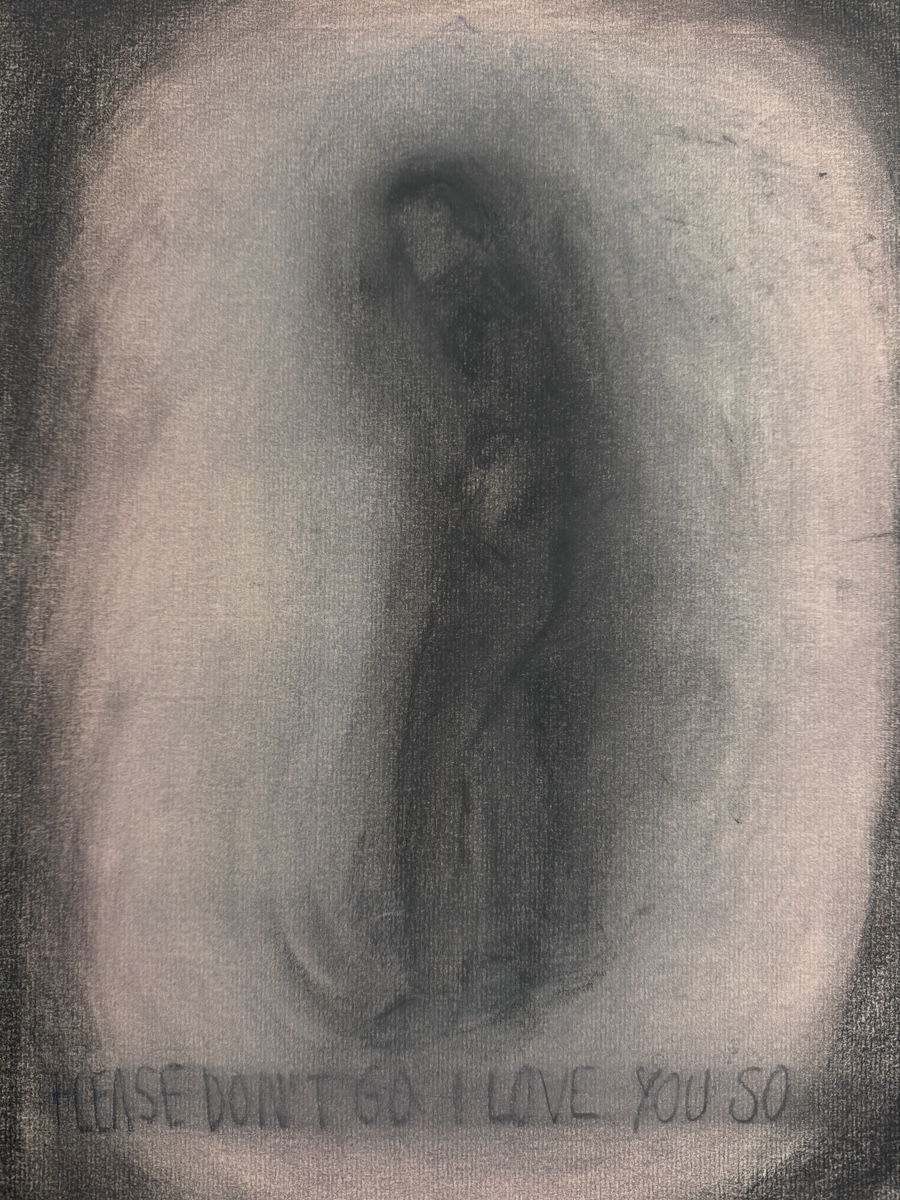
Please don’t go
i love you so
hands grip phantom shoulders
sharp small teeth curled
around Your bottom lip
gasp
sans breath of divinity
Air in my lungs
Not in yours
Grasping back of your head
Please don’t go
i love you so
abdomen curling
around your side
400 thread Cotton
bed cold
you are breeze
Please don’t go
i love you so
Thursday
2 April 2026
11:07hrs
-nusye mccomish-
This poem was written on Thursday 2 April 2026, approximately eleven months after the death of my husband in May 2025. It is not written as an attempt to produce poetry in the conventional sense, but as a record of a moment – a brief documentation of a physical and emotional state that occurred at a specific time.
During bereavement, particularly after the death of a spouse, grief is often described in emotional or psychological terms. However, what is less frequently documented is the physicality of grief: the body continuing habits of touch, the instincts to reach across a bed, the sensation of air where a body should be, the sudden awareness of cold space, the reflex to hold a head that is no longer present. The body does not immediately accept absence, even when the mind has registered the death.
This poem therefore uses physical language deliberately – hands, teeth, lungs, abdomen, bed, air – because grief at this stage is experienced primarily through the body and the domestic environment rather than through abstract thought. The ordinary objects of the home become the places where absence is most visible and most tangible. It is felt brutally in the body.
I did not intend to explain grief in this poem. Those who have experienced a similar loss may recognise the moments instinctively; those who have not may read it simply as a poem about absence. Both readings are acceptable. The poem is not written to instruct or persuade, but to record.
The refrain – please don’t go I love you so – is borrowed from alt-J’s “Breezeblocks” (2012). In the original song, the grip is possessive, almost violent. In this poem the same words perform a different desperation: the clinging is the same musculature, but it closes on nothing. The title of the source carries its own resonance – breeze blocks, the concrete units that hold walls up, against the poem’s final image of a man become breeze. I did not make this connection consciously while writing. I record it here because provenance is part of the data.
A note on capitalisation: the poem uses a single capital “Your” – at the point of greatest intimacy, the teeth curled around his bottom lip. Three moments of his body appear in the poem – lip, head, side – but they are not equal. Head and side are holding gestures, the tenderness of comfort and the shape of sleeping together. The lip is where two bodies are closest, erotic and tender simultaneously. One capital marks that distinction without explaining it. Elsewhere, ‘you’ and ‘your’ remain lowercase, including ‘you are breeze’ – where capitalisation would make him present and addressed rather what he has become – air.
My background prior to this period was in corporate finance and strategic management accounting, followed by a transition into printmaking and workshop teaching. I increasingly view writing like documentation of bereavement lived in real time.
This poem is therefore neither a conclusion, nor a resolution. It is not written to explain grief to others, but to record what it feels like to live inside it.
Nusye McComish – SouthSeaEyes – April 2026