grieving. charcoal.nmccomish

Grief on the Body: Embodied Loss and Creative Practice as Record

Embodiment, Duration, and Practice as Record

Picture of Nusye McComish
Nusye McComish

SouthSeaEyes Printmaker, MSc., CIMA CGMA

Introduction

You can read this piece in any order. it does not need to be completed in one sitting. If attention is limited, Section I stands alone. If images register more easily than text, pause at the pictures. If reading becomes tiring, stop. This writing is to reduce effort and is intended to be read with ease and without urgency.

I. Grief as Embodied Disruption

In the months following my husband’s death, I am finding grief is not only emotional experience, but also physiological. It is deeply felt in the body. It affects energy and perception, i.e. it alters how the body regulates itself and how the mind holds attention.

Everyday tasks require more conscious engagement than before. Actions that once flow automatically now requires deliberate engagement. Fatigue, oddly, is disproportionate to effort. I can do very little and feel exhausted. Sleepiness is central. 

Periods of withdrawal is a common theme. Stillness becomes frequent and ever-pressing. There are stretches of time spent indoors, seated, quietly present, without particular momentum toward activity. There are days when I sit and stare – at his photographs, our pictures when we started going out together. Not exactly resting, more a significant change in daily rhythm. 

Sensory thresholds also shift : Noise, light and visual complexity can feel more pronounced. Environments that were once neutral require greater negotiation. 

These changes persist beyond what is often expected of grief. They do not follow a neat timeline or ease simply because time has passed. What appears externally as slowness or withdrawal is, internally, an ongoing process of adjusting vigilance and managing safety. This is a continual lived state.

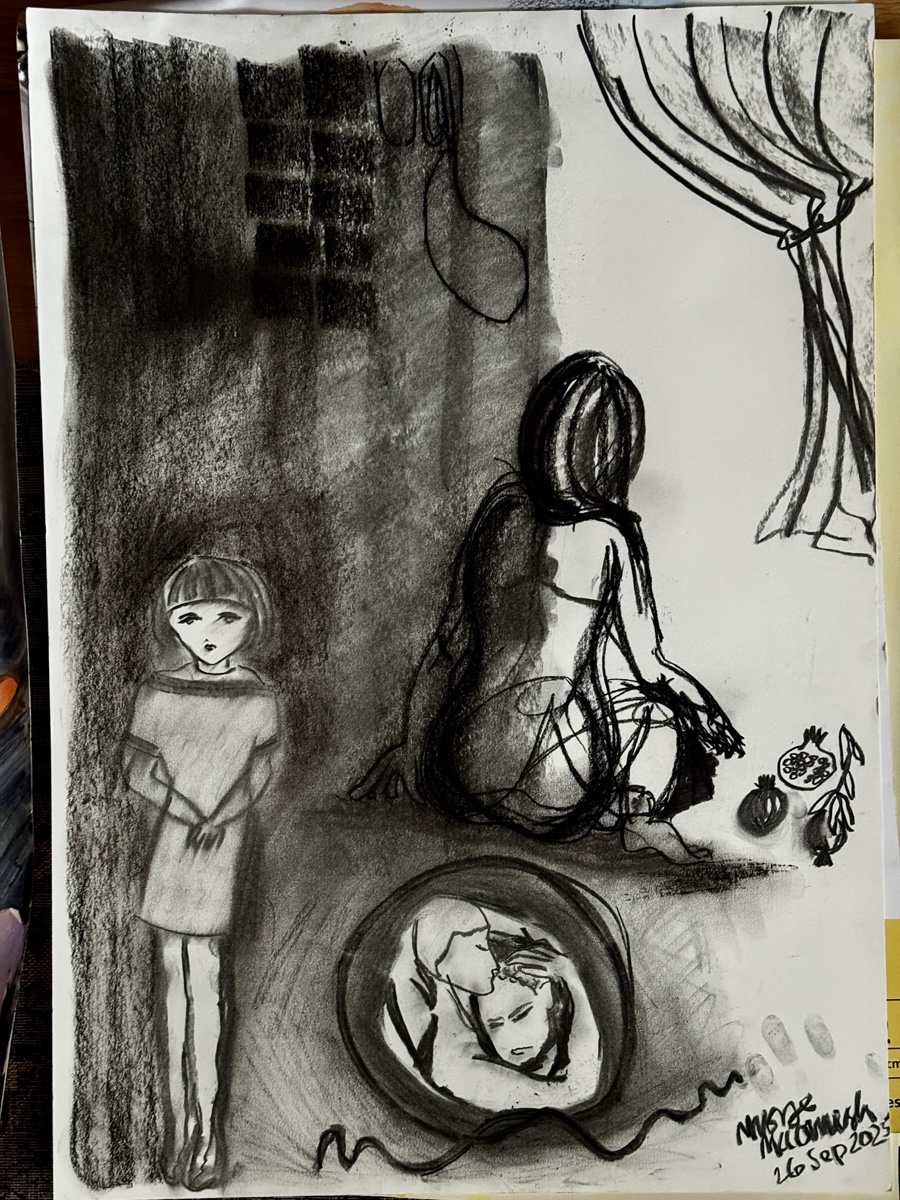
It Is Not Slowness

Charcoal on paper
It Is Not Slowness. Charcoal on paper. nmccomish
It Is Not Slowness, charcoal drawing. NMcComish

The figure appears still, but the eyes are active – holding, tracking, registering, and holding multiple permutations at once. What reads externally as pause or inertia is, internally, sustained attentiveness.

This drawing was made during a period of marked withdrawal, when movement slowed but vigilance intensified.
II. Duration And Expectation

Grief is often framed as something that softens with time. There is implied commonality in how it is expected to unfold: acute pain, gradual adjustment, eventual re-entry into familiar life. 

My experience does not follow that trajectory.

The bodily and perceptual changes described here do not diminish simply because a socially acceptable period has elapsed. Energy fluctuates. Capacity varies. The process leans towards ongoing, as opposed to ‘progressive’. 

At the same time, social and institutional systems tend to proceed as though stability has returned. Administrative and legal processes move forward regardless of internal state. This creates a quiet mismatch between what is expected and what is being lived.

Competence remains fully intact. Tasks are completed. Decisions are made. The difference lies in the cost: ordinary functioning now draws more heavily on limited reserves, and recovery takes disproportionately longer than it once did.

This is sometimes misread as inefficiency or disengagement. From within the experience, however, neither applies. It is adaptation under sustained effort.


Interlude: Pain and Numbness

Grief does not operate as a single, uniform experience. It is experienced across different layers of sensation and awareness. Pain and numbness may coexist, rather than unfold sequentially. What appears externally as composure or withdrawal may, internally, reflect the body’s effort to contain what would otherwise overwhelm it.

III. Art and Materials

Within these conditions, creative practice does not arrive as intention, but as possibility. I am not making work in order to express grief. I return to materials that accommodate altered rhythms of attention. Printmaking allows (welcomes?) interruption; charcoal allows pause. Work can stop mid-action and resumed later without penalty. 

The body moves between stillness and action as and when. There are periods of immobility, followed by brief windows where movement becomes possible. Practice occurs inside these windows. When they close, it stops. There is no sense of things moving forward. There is return to the same actions. 

The materials chosen are tolerant of these states – not in need of coherence, and no challenge for incompletion. i.e. they accept repetition and return.  In this way, the art practice mirrors the body rather than attempting to ‘correct’ it.

IV. Creating as a Record, not Remedy

Creative practice is often referred to as a form of support or ‘scaffolding’ – something that holds a person upright while they recover. I am cautious of this framing.

The work does not stabilise grief or move it toward resolution. It does not replace life or stand in for it. 

It simply records. 

Printmaking, drawing, and stitching, all register pressure, repetition and return. They hold marks of process without requiring improvement, or indeed, closure. 

So to frame the creative work as remedy would perhaps be inaccurate. To frame it as record more precise.

Grief I: Sutured In Longings Of You

Mixed media: organza, stitching, printed & inked backing.
Exhibited: POSE2025, ArtSpace Portsmouth.

Grief renders a form of violence that leaves no visible wound. Through repeated translucent figures, bound and re-bound, the work records the effort of holding together what has been structurally ruptured.  The stitching does not close the break, rather it holds it in place. 

Link: https://southseaeyes.me/2025/10/07/sutured/

This piece, as before, does not seek resolution, rather it records what it takes to continue alongside absence.

V. Documentation as Service

Speech and language is altered in grief. Speaking requires more deliberate effort. Vocabulary tends to narrow. Maintaining coherence draws on attention and energy.  This is a state which needs to be recognised in the bereaved.

By naming these changes –  fatigue, sensory narrowing, withdrawal, and altered daily rhythm, this writing offers  language for those who may recognise and already be living these conditions but struggle to articulate them. Documentation, in this case, serves as support and becomes a form of orientation.

It follows that this writing is not addressed to observers. Rather it is for those inside these states. and for those who encounter bereaved people within systems that rarely account for sustained strain.

VI. The Work As Record

Please note: This essay and the works it references are a snapshot.

I cannot honestly say at this time what creative practice will remain. I cannot say what will fall away. I am still managing death administrations, legal processes, and the daily practical demands of existing in a world that was made for two. 

The creative making, the writing, do not stand in for the life itself – but sits alongside it. They record a period of transition, being lived in real time, as conditions shift and adjustment continues. I am still here, adjusting within, learning how to exist in a space that now must hold one.

So, no – what is made here is not recovery. It does not repair what has been broken. It records the process of living-on under altered conditions, as they unfold.

past/present.pastel.nmccomish

First Christmas

When your husband was Christmas, you inherit the Turkey Problem. Navigating the first Christmas bereaved – the unfathomable grief, the planning, picking up broken pieces.

Read More »

2 responses to “Grief on the Body: Embodied Loss and Creative Practice as Record”


Discover more from Nusye McComish – SouthSeaEyes

Subscribe to get the latest posts sent to your email.

southseaeyes avatar

About the author

Hi, I’m Nusye, I am SouthSeaEyes Printmaker. My journey is rooted in personal experiences of corporate burnout, which led me to explore the healing power of art, in particular in relief printing with lino and blockprint. Drawing inspiration from my ancestral heritage on the mystic island of Java, my vibe is ancient mythologies, creating figurative art with a strong narrative focus. Join me on a vibrant artistic printmaking journey that breathes life into sacred traditions.

Discover more from Nusye McComish - SouthSeaEyes

Subscribe now to keep reading and get access to the full archive.

Continue reading

Discover more from SouthSeaEyes

Subscribe now to receive exclusive updates, early access to new prints, and invitations to upcoming exhibitions.

Continue reading