HYPERSOMNIA: STUDIES FROM THE LIMINAL
The curtains are closed.
I am asleep.
Not “having a lie-in.”
Not lazy.
Not avoiding life.
Asleep.
My consciousness has filed a formal complaint against a reality where he doesn’t exist.
My body has recognised that this is a crisis, and has promptly stuff two pencils up its nose, placed underpants upside down on its head and declared, “Wibble”.
It has decided to go on strike. This is my first introduction to what according to some literature is known as hypersomnia.¹ A rather official medical term, don’t you know. Trés modern. A form of neurological shutdown.
The body keeps the score.² The mind ransacks the memories, grasping to stay among the living. The memories—if they’re of deep love and respect—offer tenderness, warmth. Pale though they are compared to the real thing, they just have to be enough.
This is the grindstone of the bereaved.
We realise our job whilst living is to live. But we are also lost. We are bereft. We’re living through a world that has become vastly unknown, no longer deemed safe, because it is no longer the world we knew.³
Understanding that sleep is my healing and therefore in need of priority, I have paused any other form of paperwork and emails. A few months after his death, having held it together through the relentless machinery of death administration and paperwork, sleep became the priority. Day and night, the need for sleep overrode everything else. So this past week, I have given myself permission to collapse, with room for doing art, maybe even reading and writing. My form of adaptive coping, delayed processing, as well as appropriate self-care with safety net.
I sleep through random dreams. Fleeting. I can’t see him, can’t find him. The copies and clones of him are on display throughout broken dream sequences, and they are all wrong. But in my dreams he was near—even just the copy—and that offered some comfort. So I remain sleeping, with some hope of finding him.
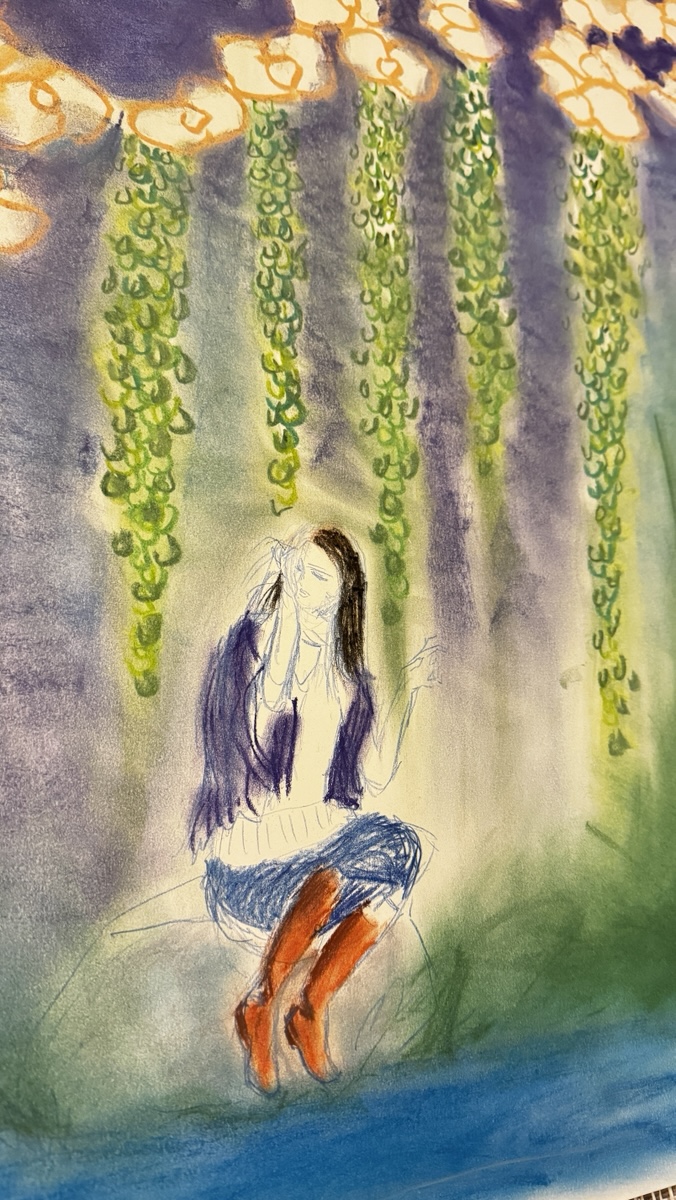
Whilst awake and with sufficient energy in store, I picked up charcoal and pastels, for forms and colours. The days are in-betweens, I eat when hungry, and when sleep is not overriding other requirements.
These charcoal and pastel studies map that space.
Liminal.
A woman—pale, alone, surrounded by nature—almost emerging, almost hidden. The figure barely drawn with blue pencil, while the environment is fully worked.
It’s very amateur, early skills. But created through hands in need of expressing internal and liminal spaces. Only the grief pushes me to create.
The curtains are closed.
And for now, they’re staying closed.